Pre-fill Techpacks with AI, and Give Your Team Hours Back Every Week
2 April 2026
Your sketch already contains everything a factory needs to know. AI can now read it, extract it, and pre-fill your entire techpack in seconds. The only thing left for you to do is design.
Techpacks are essential, and painfully slow to create
Every garment that goes into production needs a techpack. It is the single source of truth between a designer's vision and a factory's output, covering construction details, materials, measurements, trims, and finish instructions. Yet for most brands and designers, creating one from scratch means staring at a blank template and filling in dozens of fields by hand, one at a time. For a collection of thirty styles, that is hours of repetitive work before a single stitch is made.
As one designer put it: "The most time-consuming part of my week isn't designing, it's documenting what I've already designed."
AI can read a sketch and fill in the fields for you
Modern vision models can analyze a technical flat sketch, the same line drawing a designer already produces, and pull structured information out of it in seconds. Garment type, silhouette, closure, fabric estimate, construction notes, trim details, finish instructions. All of it read from the image and mapped to the exact fields of a techpack template. What used to take thirty minutes takes thirty seconds, and the designer starts from a document that is already eighty percent complete.
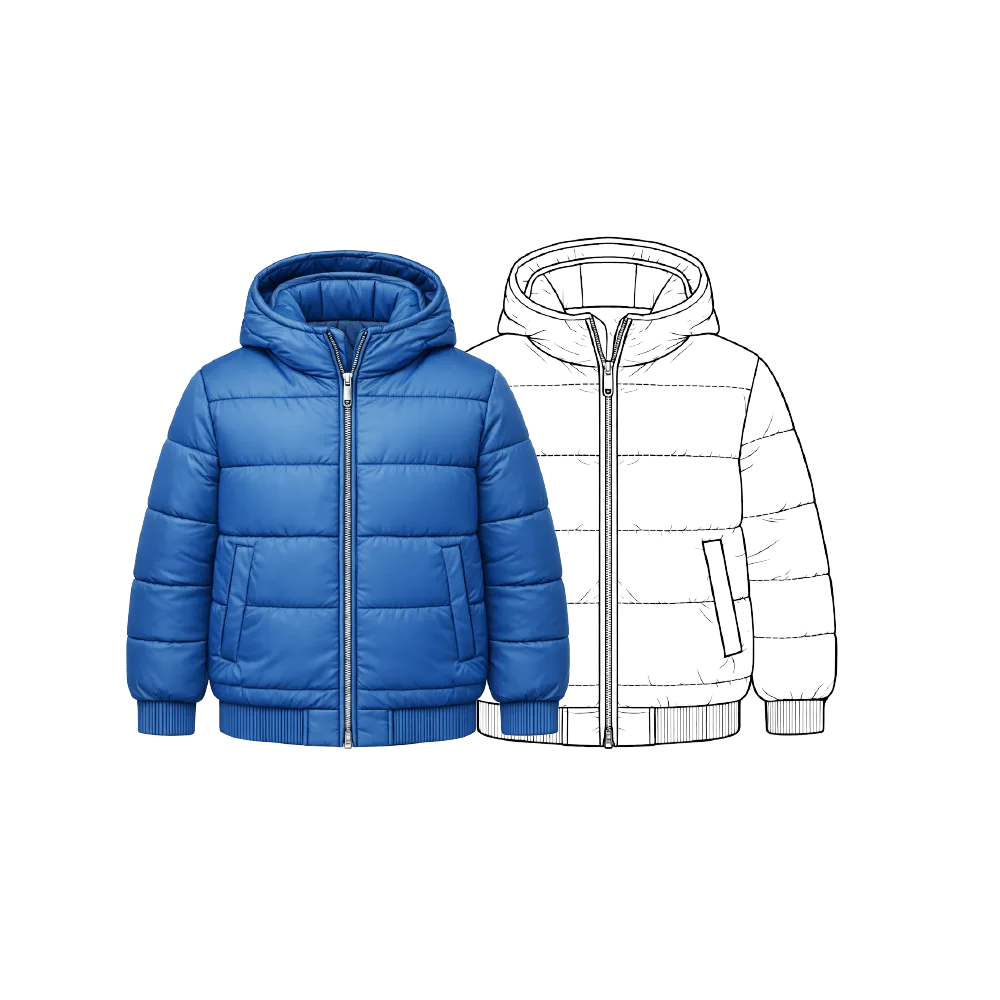
If you do not have a flat yet, you can produce one first: the studio can turn a garment photo into a flat sketch, which then feeds the same pipeline.
Upload, review, ship
The new workflow is much simpler. A designer uploads a flat sketch, clicks one button, and gets a pre-filled techpack in seconds. The AI suggests the fabric composition, writes the construction notes, lists the trims, and populates the size measurements using standard industry grading.
The designer's job shifts from data entry to quality control: reviewing what the AI proposed, correcting what needs adjusting, and adding the details only they would know. The creative work stays creative.
Every techpack structured the same way
One of the hidden costs of manual techpack creation is inconsistency. Different designers format things differently. Field names vary. Some techpacks are thorough, others are sparse. When a factory receives inconsistent documents across a single collection, errors multiply.
AI-generated techpacks solve this quietly, because the output always follows the same schema, with the same field names, the same units, and the same level of detail. Your records stay clean and your factory communication becomes far more reliable.
Less admin means more design at every scale
For an independent designer, pre-filling techpacks with AI means developing twice as many styles in a season without hiring a technical assistant. For a growing brand, it means onboarding new team members faster, since the AI carries the institutional knowledge of how a techpack should look. And for any team, the hours saved on documentation go back into what actually moves a collection forward: fabric research, fit sessions, sampling, and the work no AI can do yet.
Try it on your next style
Bring one flat sketch and see how much of the document writes itself. Open the techpack studio, or read how the techpack feature is built.