AI Fashion Models for Clothing & Accessories
Turn a product photo, flat lay or mannequin shot into on-model images worn by a realistic AI model, in any scene.
Start free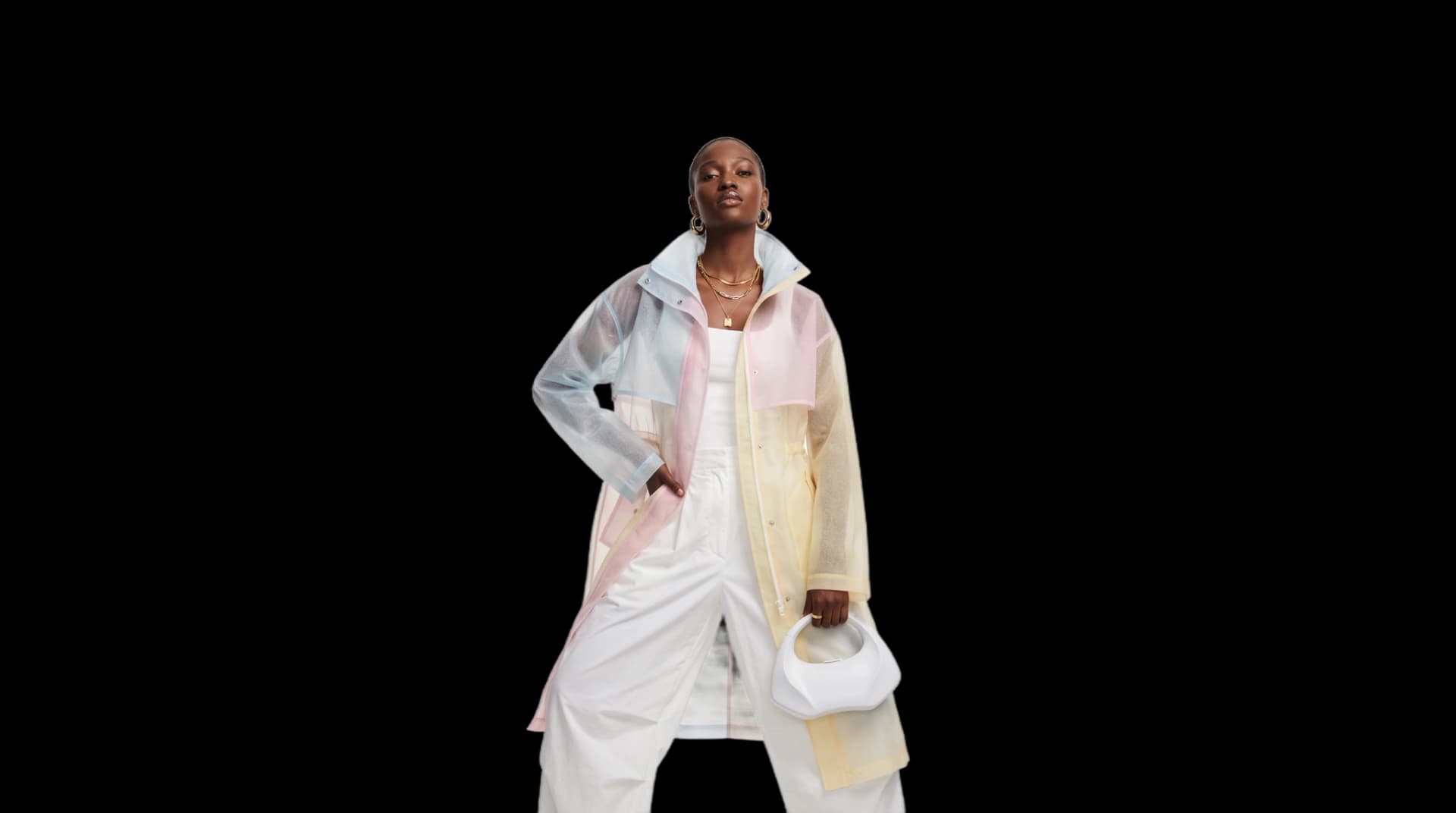
A model for clothing, shoes, bags and jewellery
AI Generated Fashion Models from Your Product Photos
Create AI generated fashion models from your product photos: clothing, shoes, jewelry and accessories worn by realistic virtual models you choose, in any setting, without a photoshoot.
Consistent AI Model Across Your Photoshoots
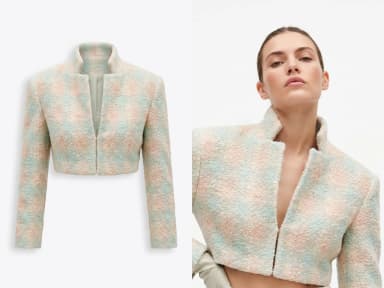
Keep the same AI model on every photo: one model reference reused in Product to Model, try-on and bulk generation, a profile in words, no training. Swap Model when the person must change.
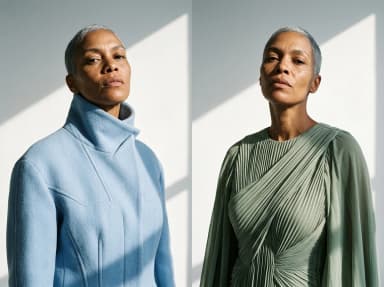
AI models by product
Go further in the studio
The model generator opens in the same workspace as everything below. These are what people reach for once the model exists: move them to another scene, change who is wearing the piece, clean the background, take the result to HD or to video.


Snap Freeze
The trending stop-and-snap reel: a raised palm stops your model, the camera explores the first piece, a finger snap switches it to the second, and they walk on. From a photo of your model and two of your pieces.


Motion Design
An animated video from your words and your photos: type, product pictures and shapes set in motion.
Edit video
Change a video with a sentence, in your own words: what you ask is what the model does, nothing added, nothing kept back.


UGC Video
A presenter shows your product and speaks to camera, smartphone style, with voice.

Model 360
Your model seen all around from a front and a back photo: the model turns on the spot, or the camera circles around them.


Face Swap
Put a new face on a photo: upload the picture to edit and a portrait of the face to use, the AI swaps the face and keeps everything else.


Ad Creative
An editorial fashion ad around your product — worn by a model, or by your own model from a photo — in the scene you describe.




Editorial Lookbook
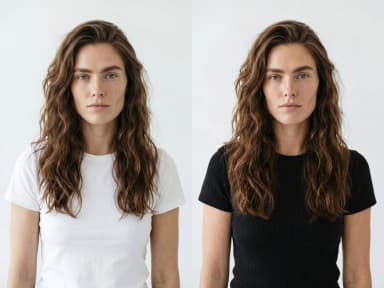
Your model in a slow, magazine-style shot: wind, light, a subtle camera move.

Remove Video Background
Cut the subject out of a video and keep it on a transparent, white, black or green background — the clip keeps its length and its shape.

Outfit Drop
The trending reel: your products fall into the frame, your model jumps and lands wearing them. From a photo of your model and two of your products.

Passer-By Transition
The trending street reel: passers-by wipe the frame and reveal your model in the next look, a few steps further down the street. From a photo of your model and two of your garments.

Reframe Video
Change a video's format without cropping: the subject is recentred and the missing edges are invented, the clip keeps its length.

Look Switch Walk
The trending crosswalk reel: your model walks toward the camera and every beat switches the look. From a photo of your model and two of your garments.

Change Video Background
Put the model of a video somewhere else: the person, the outfit and the movement stay, the setting is described in words.

Edit Outfit in Video
Change the clothing in a video with a sentence: a new colour, a new print, another garment — the person, the movement and the setting stay.

Hanger Switch
The trending hanger reel: your model holds up two hangers and is instantly wearing both pieces — layered or top and bottom — then two more. From a photo of your model and two pairs of garments.

Swap Model in Video
Another person in the same video: give a photo of the new model, the outfit, the movement and the setting stay.

Window Walk-By
A fixed shot through a tall window: your model walks in from the left, poses, walks out right — and comes back in the next look. From a photo of your model and two garments.

Detail Zoom Rush
A fast detail reel: the camera rushes in on one detail of the look, pulls back and rushes in on the next, in one move. From a photo of your model in the outfit.

Outfit Morph
A fixed shot on your model as one look morphs into the next, with no cut. From a photo of your model and three garments.

Create a Soundtrack
Compose an original track from a prompt and an optional picture, or lay a soundtrack on one of your videos.

Create a Voice-over
Write a text and choose a voice: it is read aloud and saved as an MP3, ready for a video, an ad or a product page.

Collection Panorama
Six cut-out looks stand in a row on a studio backdrop; the camera travels along them and back, the close-up passing in front, a title at each end of the path. Give it photos or videos with a transparent background.
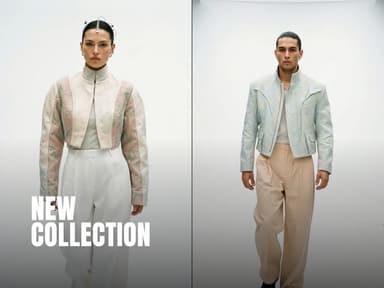
Split Reel
Two halves wipe through your four photos or clips while a headline, then a second one and a small line, rise letter by letter. Made for launches and drops.
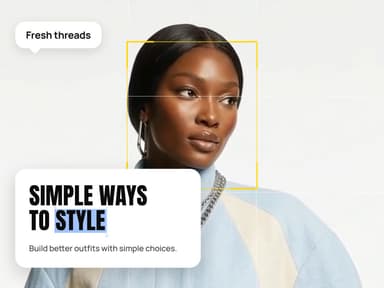
Style Post
One photo or clip framed like a camera, a speech bubble, then a card whose headline rises word by word and highlights its last word. For tips and new-in posts.
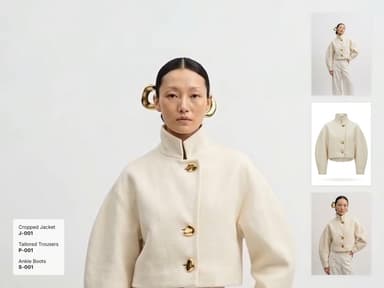
Look Film
Your look in motion, full frame, with three photos or clips of it in a column beside it and the pieces worn listed below. For drops and new-in posts.
Colour Drop
A big word, then each look slides in on its own colour: the band, the tags and the line at the bottom take it. For a range in several colourways. Cut-out photos or clips (transparent background).
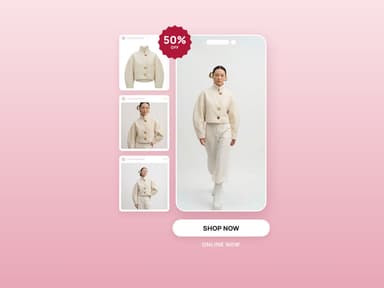
Phone Promo
Your look playing in a phone, three product cards beside it, a sale badge and a call to action. For promotions and drops.
Cut Montage
Hard cuts in the rhythm of a campaign film: full frame, punch-in close-ups, the look framed in a colour panel, opened and closed by a word. Three to six clips or photos.
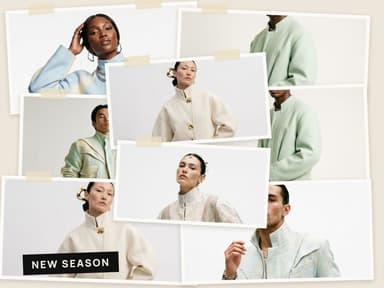
Paper Collage
Prints taped on a paper ground, pinned one over the other; once the board is full the pictures trade places in quick cuts, like a moodboard being reworked. Four to eight pictures.
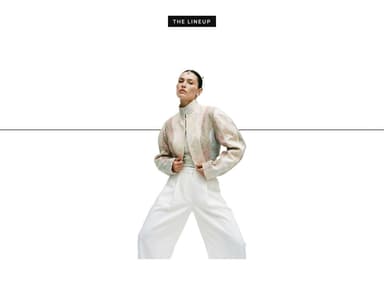
Lineup
A white page and a thin line: one look at a time takes the centre, each change a short glitch; then the whole line steps in, two looks close in front. Cut-out photos or clips (transparent background).
Character Select
Columns of garments and full looks roll like a slot machine, stop and roll again, then a line asks to choose. Three garments and three looks, cut-out (transparent background).
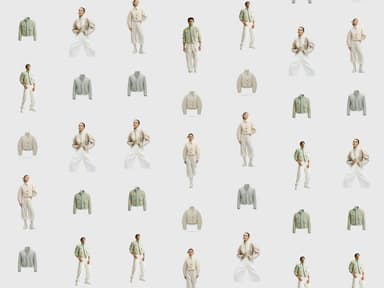
Grid Mosaic
One look cut into a grid drawn in one colour: two small portraits and a large one above, the full look and two crops of the legs below. The cells open one by one and trade places on the beat. A portrait and a full look.
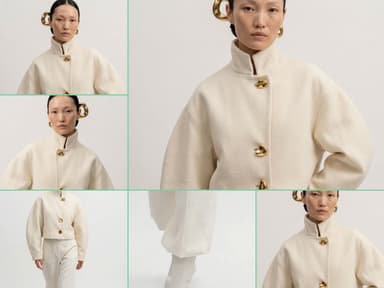
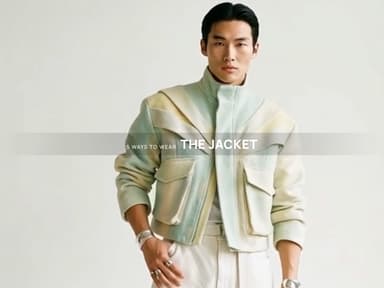
Ways to Wear
One piece, several ways to wear it: each look fills the frame and the next pushes it out behind a straight edge, while one line stays across the middle. Three to six clips or photos.
Detail Study
A look in full under a spaced name, then the camera goes close: the face in black and white, the fabric, the waist, the hands. Each cut arrives out of a blur, and the film ends on the last look in full. One to three clips or photos.
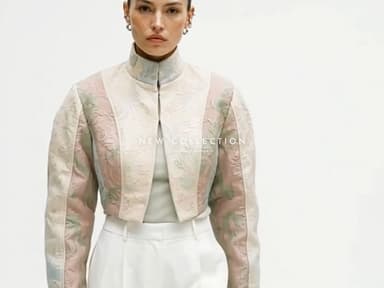
Signature Film
Slow, quiet shots of the collection (full length, three-quarter, close) joined by short dissolves, a thin spaced name across the first ones, and the name alone on a dark card to close. Two to four clips or photos.
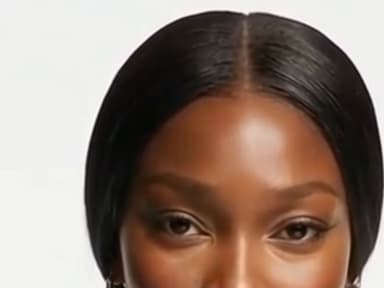
Outfit Picker
A look stands in the studio with the others in small cards at its feet. A pointer goes to the next card, clicks, and the look changes, like choosing a player. Two to four cut-out photos or clips (transparent background).
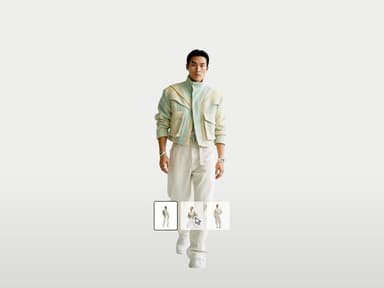
Beat Cut
The studio wall and the looks cut on the beat: wide, close, wide again, one look then the next, faster and faster, the way a campaign teaser runs. Two to four cut-out photos or clips (transparent background).
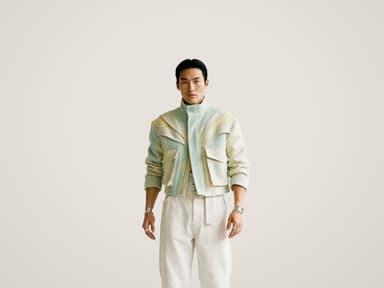
Bold Word
One heavy word across the looks while they change on the beat, facing one way then the other, with a small line under the word. Two to four cut-out photos or clips (transparent background).
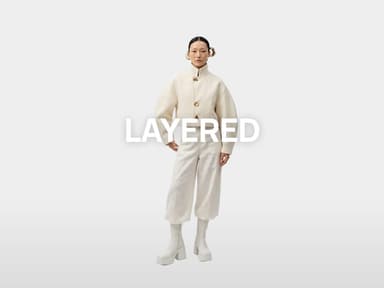
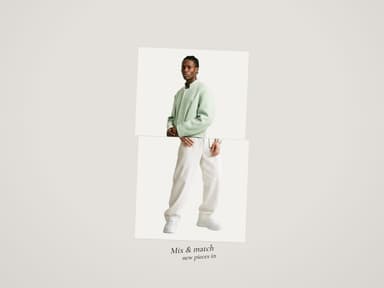
Mix & Match
Each look printed and cut in two at the waist, the top and the bottom on two paper cards. The tops change, then the bottoms, so every pairing passes, with a handwritten line under the cards. Two to six cut-out photos (transparent background).
Learn
Clothing product photography with AI
The images a product page needs, how to make each one from a single photo of the garment, and what still needs a camera.
ReadThe best AI fashion model generator
Photorealistic models, a real demographic range, pose control, and the same face across a whole shoot.
ReadA consistent AI model
Train the AI on photos of one person and generate the same face across every shoot.
ReadGenerate your catalog in bulk
Turn a product catalog into AI models, videos or virtual try-ons in one run.
ReadWhat an AI fashion model is, and how one is made
An AI fashion model is a person the studio generates so that your product can be photographed worn. You bring the piece, you say who should wear it, and what comes back is a photograph of that item on a body: the pose, the light, the way the fabric falls and creases around a shoulder.
The starting point is almost always a flat lay. A garment photographed on a table carries everything about how it is built, and nothing about how it looks worn, which is exactly the gap. The studio reads the construction from the flat picture and rebuilds it on a figure, so the collar sits where a collar sits and the hem falls where the cut says it should.
That is the whole of it, and it is worth being clear about what it replaces. Not the design, not the product photograph you already own, and not the decision about what to make. It replaces the booking: the model, the studio, the day, and the wait between the sample arriving and the picture existing.
How do I choose who wears it?
The most common disappointment with generators of this kind is that the person who appears was chosen by the machine. Here they are chosen by you, in fields rather than in prose.
Gender. Age, from twenty to sixty in steps of five. Origin. Body shape. Each is a setting, not a phrase you have to word cleverly, which matters more than it sounds: a prompt that says "a woman in her forties" competes with everything else in the sentence, while a field is simply obeyed.
Practically, this is what makes the studio useful for a range rather than a single image. Change one setting, generate again, and you have the same garment on a different person with nothing else moved. A brand that wants its knitwear shown on a twenty-five year old and on a fifty-five year old is two generations apart, not two shoots.
What photo should I start from?
The product picture decides most of the result, and the rule is one sentence long: the whole piece visible, nothing covering it, in as much resolution as you have.
A flat lay on a plain ground is the reliable case. A garment hung, or on a mannequin, works just as well. What costs you is anything that hides construction: a sleeve folded under itself, a closure buried in a fold, a crop that cuts the hem, a patterned surface underneath that competes with the piece. Every one of those is information the studio then has to invent, and invention is where a result stops looking like your product.
Colour deserves its own line. A garment photographed under a warm indoor bulb comes back warmer than it is, and a white that was actually daylight-white arrives cream. Shoot the piece in even light if you can, because a colour corrected afterwards on the finished image is a colour corrected on skin and background too.
What makes a result look real?
The question people actually ask, in those words, and the honest answer is that realism is mostly decided before you press generate.
Three things carry it. Resolution first, because detail that is not in the product photograph cannot appear on the model. Then the match between the piece and the person: a heavy wool coat on a very slight figure asks the studio to reconcile two things that rarely meet, and the seam of that compromise is what a viewer notices without being able to name it. And finally consistency of light, which is why a product shot taken in flat, even light composes into more scenes than one lit with a hard side lamp.
What gives a result away, when it does, is usually a hand, a piece of fine hardware, or small printed type at full-body scale. If the buckle is the product, photograph the buckle close and show it in its own frame rather than asking a full-length picture to carry it. That is not a workaround, it is what a catalogue does anyway.
Can I keep the same model across a collection?
This is the difference between having pictures and having a campaign, and it is the request that comes second, always, right after the first image works.
A model can be kept as a consistent identity and used again across a range, so twenty products come back worn by one recognisable person rather than by twenty strangers. A collection page then reads the way a shoot reads. Swap Model does the reverse when you need it: keep the outfit exactly as it is and change who is wearing it, which is how one photograph becomes a range of models without regenerating the garment each time.
And once the person exists, they are not stuck in the frame they were born in. Reimagine your Model moves them into another scene entirely, so the same look can go from a plain studio wall to somewhere with weather in it.
What it costs, and how long it takes
One credit on Standard, three on Pro, per attempt. Nothing is charged for uploading and nothing for looking at the result. A new account opens with three free credits, so the first models cost nothing beyond signing up.
An image comes back in about fifteen seconds, measured on our own platform rather than estimated. That pace is what changes the method rather than the budget: when a model costs a credit and a quarter of a minute, you stop choosing between two options in a meeting and simply generate both.
Can I do a whole catalogue at once?
One product at a time is how you explore. A catalogue is a different job, and Product to Model is one of the workflows that runs in bulk.
You give it the products and the model who should wear them, and the batch is generated in one pass rather than one upload at a time. Combined with a consistent model, that is a full season presented by one person, which is the thing a range page needs and the thing separate shoots almost never deliver.
What an AI model is not
Worth stating plainly, because the industry is arguing about it and a brand using this should know where it stands.
The person in the picture does not exist. They are generated for the purpose of showing a garment worn, and they are good at exactly that. What they cannot do is carry a life: a generated face has no experience to speak from, so a synthetic person should present a product and should never be presented as a customer, a testimonial or an endorsement. That line is easy to hold and expensive to cross.
The settings do let you show a genuinely wide range of ages, origins and body shapes, and using them well is better than not. It is also not the same thing as working with the people themselves, and a brand that means the wider representation seriously will do both rather than one instead of the other.
Finally, a real person's likeness is theirs. If you upload a photograph of someone to put your product on them, their consent is yours to obtain, not ours to assume. Rules on disclosing that an image is AI-generated differ by market and by platform, and they are moving; check the ones that apply to you rather than the ones that applied last year.
Edit with smart creative tools
Refine your generated visuals with smart editing tools: crop, trim videos, add clips, text, filters and more.
Publish directly to Shopify and channels
Schedule or publish your images and videos directly to Shopify, Instagram, Pinterest, TikTok, YouTube, X, Threads, and more.
Create directly in Claude chat
Create faster with The New Black AI through our seamless Claude MCP integration.
ConnectInvite your team
Seats come with every plan, unlimited from Business. Work on projects, edit and publish together.