10 Best AI Pattern Making Software in 2026 (Compared)
Published 13 November 2026
For a pattern maker who wants to see the fit before cutting a toile, CLO 3D and Browzwear are the two references, and Browzwear is the one with a published self-serve price. For a production pattern room that lives on grading and markers, Lectra Modaris and Tukatech TUKAcad, with Tukatech the cheapest way in. For AI that actually returns a pattern, fashionINSTA is the only tool here that trains on your own DXF archive, at an enterprise price. Seamly2D and Valentina are free. The New Black AI, which we make, does not draft sewing patterns: it fits the steps around the pattern, the flat sketch, the vector, the tech pack with its graded size chart, and a 3D view of the garment, so we place it last and say exactly where it helps.
Updated November 2026.
Quick answer
- Best for 2D patterns tested on a 3D avatar: CLO 3D, or Browzwear if you want a price you can read before you call anyone.
- Best for a production pattern room (grading, markers, cutting): Lectra Modaris, or Tukatech TUKAcad from $19 a month.
- Best for AI that generates real DXF patterns: fashionINSTA, trained on your own pattern archive.
- Best free pattern software: Seamly2D or Valentina, both open source.
- Best for the flat, the tech pack and the graded size chart around the pattern: The New Black AI (we make it; it does not make patterns).
The 10 tools at a glance
| Tool | Best for | Starting price (checked Nov. 2026) | Free option | What the AI does on the pattern |
|---|---|---|---|---|
| CLO 3D | 2D pattern with live 3D drape | See their site | Trial, see their site | Little: the AI sits around the pattern, drafting stays manual |
| Browzwear VStitcher | 3D development priced self-serve | $75 a month or $750 a year (Freelancer) | Learner license for students, six months | AI capabilities listed on the Teams plan, limited to 50 credits |
| Lectra Modaris | Production patterns and grading | On quote, 1 to 3 year commitment | No | Parametric tools, no AI named on the product page |
| Tukatech TUKAcad | Pattern, grading and markers at a published price | From $19 a month | No | Automatic pattern making from measurement specs |
| Style3D (Studio, Assyst.CAD) | 3D simulation with automation of patterns and trims | See their site | Try Now portal | Says it automates patterns and trims |
| Optitex | 2D and 3D CAD with automatic nesting | On quote | No | Automation (grading, nesting), no generative AI |
| Audaces | Pattern, grading and digitizing in one suite | On quote | Student plans on quote | Digitizes a paper pattern from one photo; AI for design ideas |
| fashionINSTA | AI trained on your DXF archive | €5,000 to €15,000 pilot, then €23,900 a seat a year | No | Generates new DXF patterns from your own blocks |
| Seamly2D and Valentina | Free parametric drafting | Free | Free, open source | None |
| The New Black AI | Flat, vector, tech pack and size chart around the pattern | $15 a month for the Starter plan | Two tech packs without a plan, and free credits at signup | None on the pattern; it grades the size chart and draws the flat |
How this comparison was made, and how the order is set
We read each company's own site in November 2026: Browzwear's pricing page and its February 2026 announcement of self-serve plans, Tukatech's home page, Lectra's Modaris page, Style3D's home page and the Assyst.CAD page, Optitex's home page, Audaces' home page, fashionINSTA's home page, and the Seamly and Valentina project pages. We did not install these programs, buy a plan or draft a pattern in any of them: « their site says » means exactly that. CLO's site did not open for an automated reader in November 2026, so CLO is described from what it is publicly known for, and its price is « see their site ».
The criteria are the ones a pattern maker asks about. Does the software draft and edit 2D pattern pieces? Does it grade, and with your own grade rules? Does it make markers, or hand off to a cutting room? Does it show the pattern sewn on a 3D avatar? Does it read and write DXF, the file a factory's CAD opens? What does the AI do on the pattern itself, as opposed to around it? And what does it cost to start, at one seat?
The order follows one job, a pattern maker getting a style from block to production pattern, and one question: how much of that job does the tool carry? 3D pattern tools come first because they cover drafting, grading and fit. Production CAD suites follow, then the AI pattern specialist, then the free tools. The New Black AI is last because it does not draft patterns at all. We make it, and on most of our comparisons we put it first because it covers the most steps for a fashion brand. On this subject it would be wrong: a pattern maker cannot replace their pattern software with it. What it can replace is the work around the pattern, and that is what its section says.
The tools, and what each fits best
CLO 3D: best for drafting a pattern and seeing it drape before the toile
CLO 3D is built around the pattern. You draft or import 2D pattern pieces, the software sews them together on an avatar, and fabric physics shows the drape, the tension and the ease. Every change to a dart, a seam or a curve shows up on the 3D garment, which is why brands and schools use it to cut the number of physical samples. It reads and writes pattern files that factory CAD systems open, and the same file carries on into renders for the line review.
Who it fits: a technical designer or a freelance pattern maker who presents digital samples to clients, and a brand that wants fit decided on screen before a sample is sewn. It is also the tool most schools teach, so it is the easiest one to hire for.
What the AI does: it works around the pattern (textures, graphics, renders) rather than drafting it. Drafting in CLO is still skilled CAD work, and you need to know how a pattern is built to use it.
Price: CLO's own pricing page did not open for us in November 2026, so we give no number: see their site, where an individual plan and a trial are offered.
The honest limit: 3D simulation needs a capable computer, and the learning curve is real. If you only need 2D production patterns and grading, a CAD suite like Tukatech or Modaris does that job without the 3D.
Browzwear VStitcher: best for 3D pattern development with a price you can read
Browzwear's VStitcher is the 3D garment development tool many large apparel companies run: pattern editing, grading, drape simulation, renders, and Stylezone for review and approvals in the cloud. Until 2026 it was sold through sales. In February 2026 Browzwear launched self-serve plans, and its pricing page now lists them.
Price (Nov. 2026): Freelancer is $75 a month or $750 a year, for one user and one site, with the newest VStitcher version and community support. Freelancer Plus is $150 a month or $1,500 a year and adds the latest two versions and the tech pack with guest invites. Teams is $3,950 per user per year, for up to three named users, with cloud rendering and email support. Enterprise is custom. Students enrolled in accredited programs and graduates within six months of graduating can apply for a free six month Learner license, for non-commercial use, with limited features.
What the AI does: on the pricing table, « AI capabilities » appear on the Teams plan, limited to 50 credits in total, and on Enterprise. The Freelancer plans list no AI. So, for a single pattern maker, Browzwear is 3D pattern software, not AI pattern software.
Who it fits: a freelance pattern maker who wants the tool their brand clients use, at a monthly price, and a small team that will grow into the enterprise platform.
The honest limit: the step from $150 a month to $3,950 per user per year is steep for a small team, and the AI features sit behind it.
Lectra Modaris: best for a production pattern room that grades every style
Lectra's Modaris is pattern software for production. Its page says it covers the work « from the creation of base patterns to the approval of final patterns and 3D prototypes »: create a pattern from a basic block or an existing variant, change style lines and points, add notches, seam allowances and axes, grade to every size, and sync the 2D production pattern with a 3D prototype in Modaris 3D. Modaris Expert, the top tier, has parametric tools, and Lectra says they save up to 30% of pattern adjustment time. Lectra also owns Gerber: gerbertechnology.com now redirects to lectra.com, AccuMark is still listed among its fashion products, and the Modaris Pattern Converter reads AccuMark files (up to V16), DXF AAMA and DXF ASTM.
Price (Nov. 2026): no price on the page. It is a subscription with a commitment of one to three years, and a license brings two upgrades a year. Contact Lectra.
What the AI does: the Modaris page names no AI feature. Its gains are parametric: change one measurement and the pattern follows.
Who it fits: a manufacturer or a brand with its own pattern room, a cutting room, and a Lectra or Gerber history.
The honest limit: a quote, a commitment of a year or more, and training. It is too much for a founder making one capsule.
Tukatech TUKAcad: best for professional pattern CAD at a published price
Tukatech is one of the few pattern CAD makers that put a price on their own site. Its home page describes TUKAcad as tools to « create, modify, grade, and prepare production-ready patterns », and it can generate patterns from measurement specs through automatic pattern making. SMARTmark automates marker making and material planning to use less fabric. TUKA3D, a separate product, tests garments on pattern-based digital fit models.
Price (Nov. 2026): « start a TUKAcad subscription from $19/month », on the home page. The page does not say what the $19 edition includes; a banner says TUKAcad 2026 subscribers get pattern and 3D assets for free. Check the edition before you buy, since the cheapest one is usually a learning edition with limits.
What the AI does: the automation is pattern generation from measurements and automatic markers. It is algorithmic, not generative, and for a cutting room that is the kind that saves money every day.
Who it fits: a student, a freelance pattern maker or a small factory that wants professional grading and markers without a quote process.
The honest limit: 3D is a separate product, and the interface is that of a CAD tool built for pattern rooms, not for designers who have never drafted.
Style3D: best for one vendor from 3D simulation to production patterns
Style3D builds its own simulation engine for deformable materials, and sells a family of products on top. Its home page puts Style3D Studio under development with this sentence: « AI-driven 3D simulation connects design to production, reducing sampling and automating patterns and trims. » The same page lists Assyst.CAD, the German 2D pattern CAD that Style3D now sells: pattern construction, visual grading of a complete size range, markers made manually or automatically from the pattern, and Smart.Pattern macros, more than 270 of them, 60 included free. Style3D AI covers design ideas and marketing renders, and Style3D Cloud the assets and the team.
Price (Nov. 2026): no price on the pages we read. A Try Now portal and a demo are offered: see their site.
What the AI does: Style3D makes the strongest AI claim about the pattern among the big 3D vendors, in automating patterns and trims. The page does not detail how, so test it on one of your own styles.
Who it fits: a brand that wants the 3D simulation, the 2D pattern CAD and the marketing renders from one vendor.
The honest limit: several products to map onto your workflow, and no public price, so you cannot budget without a call.
Optitex: best for 2D and 3D pattern CAD with automatic nesting
Optitex says it plainly on its home page: « driven by precision, powered by efficiency ». It sells an interoperable 2D and 3D portfolio, user-friendly pattern making and nesting tools, functional grading « to achieve full production-ready digital patterns », automatic nesting for early costing, and collaboration across the supply chain. It is open to standard software and hardware formats, which matters when your factory runs another CAD.
Price (Nov. 2026): no public price. A contact form on the site: see their site.
What the AI does: Optitex does not market AI. Its automation is grading and nesting, done well.
Who it fits: manufacturers and brands that cut in volume and care about fabric yield, and teams that also make soft goods outside apparel.
The honest limit: the buying process of an enterprise suite, and no generative feature if that is what you came for.
Audaces: best for digitizing paper patterns and grading in one suite
Audaces, from Brazil, sells pattern software from design to the cutting room. Its home page lists Audaces Pattern, to « create and grade your patterns digitally », and the Digiflash family, which turns existing paper patterns into digital ones: Digiflash for paper patterns, Digiflash XT as a digitizing table, and Digiflash Device, which stores a pattern digitally from a single photo. Its AI tools on the same page are LooksMaker, for fashion designs, and Clickfy.ai, for e-commerce images.
Price (Nov. 2026): no price on the page. Plans for companies, students and institutions, on request: see their site.
What the AI does: the AI sits on the design and the images. On the pattern, the useful part is the digitizing: a pattern room with years of paper patterns can bring them into the software without retracing.
Who it fits: a workshop or a brand with an archive of paper patterns, and a manufacturer that wants pattern, marker and cutting from one supplier.
The honest limit: quote only, and the AI does not draft the pattern.
fashionINSTA: best for AI that generates DXF patterns from your own archive
fashionINSTA is the only tool on this list that sells AI on the pattern itself, and its home page is precise about how. It trains on your production DXF archive, « 100 to 150 of your .DXF patterns », one category at a time, in about four weeks. The AI then retrieves the closest matching pattern for a new sketch, or « generates new patterns from your trained building blocks », as real DXF files to open in CLO3D, Gerber, Browzwear or Lectra. Fit parameters stay locked unless a technical designer unlocks them. Each customer runs on its own dedicated instance, and its patterns never train another brand's system. The founder is a former seamstress and product development lead.
Price (Nov. 2026): a scoped pilot of €5,000 to €15,000, one time, then €23,900 per seat per year, with volume pricing.
What the AI does: it recombines your own approved blocks into new patterns, graded in your fit. It does not invent a fit from nothing, which is what a pattern room should want.
Who it fits: a brand or a manufacturer shipping many styles a year, with an archive of approved patterns and a pattern room that is the bottleneck.
The honest limit: it needs the archive, the pilot and the budget. A new brand with no patterns has nothing to train it on.
Seamly2D and Valentina: best free pattern drafting software
Seamly2D and Valentina are open source pattern drafting programs from the same origin. Seamly's site says « Seamly is Free and Open Source », under the GPLv3 license, for Windows, Linux and macOS, with size charts, made-to-measure data and, in beta, the conversion of a body scan into Seamly measurements. Valentina's project page offers release 0.6.1 for Windows, macOS and several Linux systems. Both draft with formulas tied to measurements, so a pattern built once redrafts itself for another body or another size: « from basic slopers to any pattern made to specific measurements », as one user puts it on Seamly's page.
Price (Nov. 2026): free.
What the AI does: nothing. The intelligence is the parametric drafting, which a pattern maker controls line by line.
Who it fits: students, home sewers, costume makers, made-to-measure tailors and small brands drafting their first blocks.
The honest limit: no 3D, a small support community instead of a vendor, and a factory may ask for a file format that takes a conversion step.
The New Black AI: best for the flat, the tech pack and the graded size chart around the pattern (we make it)
We make The New Black AI, so weigh this section accordingly, and read its first line: it does not draft sewing patterns, and it exports no DXF. If you need pattern pieces, use one of the tools above. Where it helps a pattern maker is everything that arrives on their desk with the style, and everything that leaves with it.
Before the pattern: the flat sketch from a photo turns a sample or a reference photo into a technical flat, front, back or both, for 1 credit on Standard AI and 3 on Pro. Sketch to SVG redraws a flat or a pen drawing as a clean vector, one path per line, sorted into silhouette, seams, details, stitching and hardware, for 10 credits in one to four minutes. A designer's sketch then reaches the pattern maker as a drawing with clear seams instead of a phone photo of a notebook.
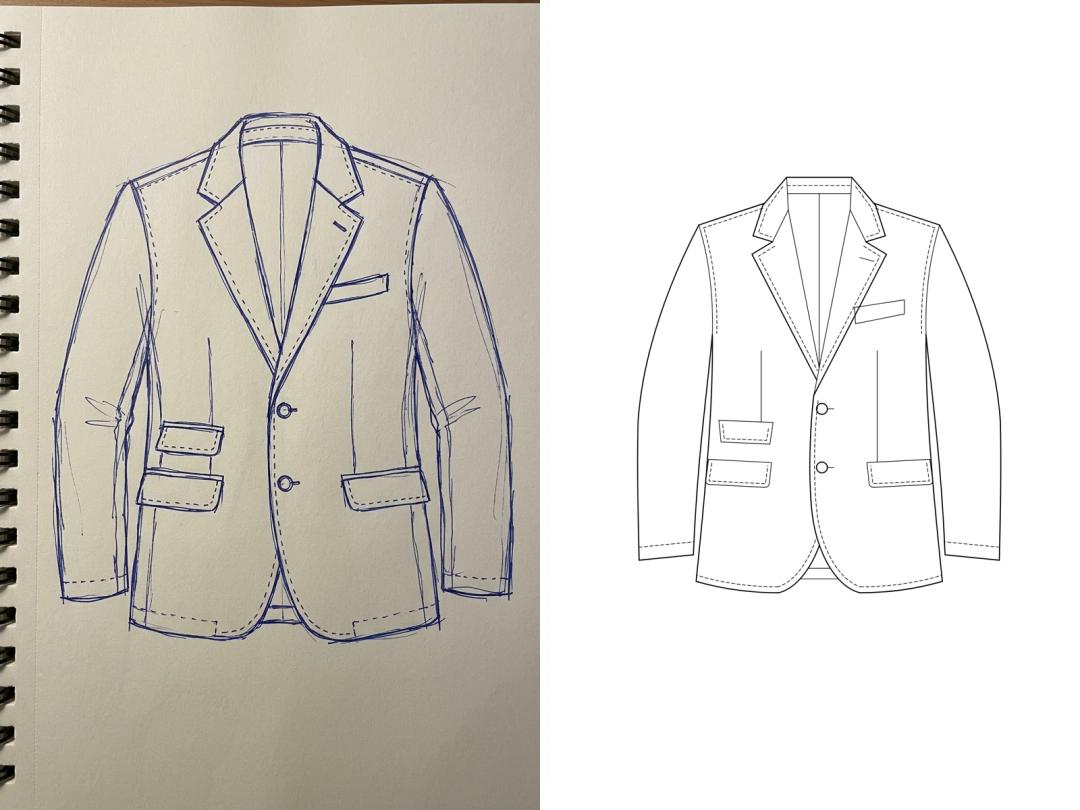
*A pen sketch of a blazer and the SVG flat Sketch to SVG redrew from it: straight seams, smooth curves, every line its own path.*
Beside the pattern: the tech pack holds the points of measure, each with its code, its value per size and its tolerance, and the callouts on the flat carry the same codes as the table. The AI size chart writes the whole graded chart for 1 credit, each point of measure with its own increment, and follows your own sizing and grading sheet if you give it one. A measurement you state is kept as a fact and the other sizes are graded from it. That is the spec a pattern maker grades the pattern against.
After the pattern: Image to 3D turns a photo of the sample into a turnable 3D model for 10 credits, exported to FBX, USDZ, OBJ, STL, 3MF or glTF. It is a mesh rebuilt from a photo, not a garment simulated from pattern pieces: it shows the volume for a presentation, it does not test the fit.
Price (Nov. 2026): Starter is $15 a month for 200 credits, Pro $35 for 500, Business $65 for 1,000. Building and exporting a tech pack by hand is free, two packs without a plan and unlimited on any plan, and a new account opens with free credits at signup.
The honest limit: no pattern pieces, no grading of a pattern, no markers, no DXF. It prepares and documents the style; the pattern is made elsewhere.
What it costs to equip one pattern maker
Pattern software is priced per seat and per year far more often than per use, so the useful number is the yearly cost of one seat, and what that seat covers. Only the prices we read ourselves in November 2026 are used below.
| Setup | Yearly cost, one seat | What it covers |
|---|---|---|
| Seamly2D or Valentina | $0 | Parametric drafting, no grading suite, no 3D |
| Tukatech TUKAcad, entry edition | From $228 ($19 × 12) | Pattern, grading; check the edition's limits |
| Browzwear Freelancer, yearly | $750 | 3D pattern development, one user, no AI |
| Browzwear Freelancer Plus, yearly | $1,500 | Adds two versions and the tech pack with guests |
| Browzwear Teams | $3,950 per user | Up to three users, cloud rendering, 50 AI credits |
| fashionINSTA | €23,900 per seat, after a €5,000 to €15,000 pilot | AI generating DXF from your archive |
| CLO 3D, Lectra, Style3D, Optitex, Audaces | See their sites, or on quote |
The New Black AI does not belong in that table, because it replaces none of these. It sits beside one of them, and the next section prices that.
Worked example: a 12-style capsule, from sketch to the pattern maker's desk
A small brand has 12 styles for its next drop, a sample or a photo of each, and a freelance pattern maker on Tukatech. Before the pattern work starts, the pattern maker wants, for each style, a clean flat front and back, a vector they can annotate, and a graded size chart in the brand's own scale. Here is that preparation on The New Black AI, at the credit prices read in the product in November 2026.
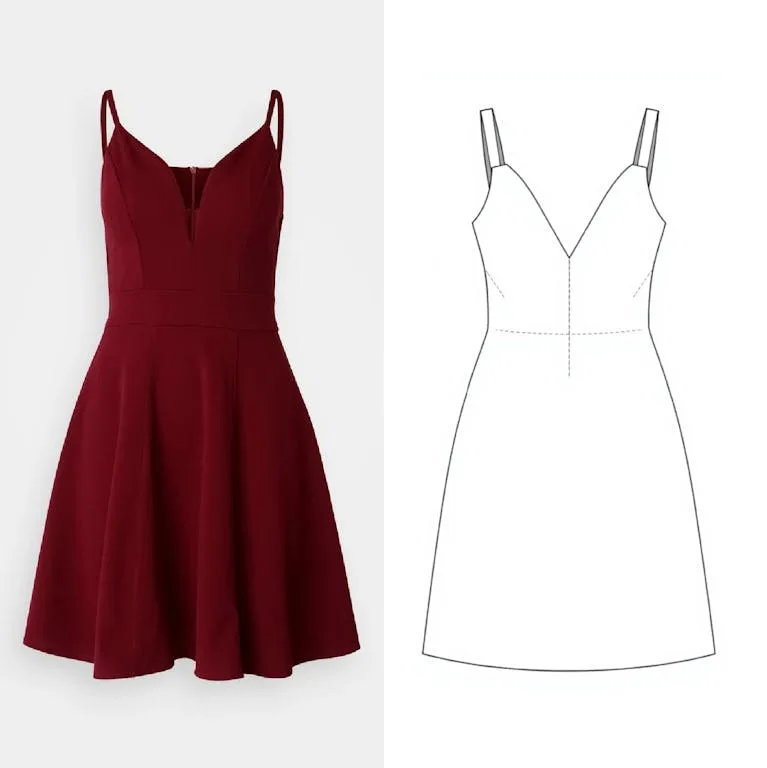
*A photo of a strap dress and the flat sketch the tech pack drew from it: the drawing the pattern maker starts from.*
Per style:
- The tech pack's AI draft from the photos: 1 credit.
- The flat sketch it draws, front and back: 1 credit each, 2 credits.
- The size chart graded with the brand's sizing sheet: 1 credit.
- The AI review that reads the pack as a factory would: 2 credits.
- Sketch to SVG on the flat, front and back in one image: 10 credits.
That is 1 + 2 + 1 + 2 + 10 = 16 credits a style. For 12 styles: 12 × 16 = 192 credits. The $15 plan carries 200 credits a month, so one month covers the capsule.
Adding Image to 3D on the four hero pieces is 4 × 10 = 40 more, 232 in all. That is past the 200 of the $15 plan: one month of Pro, $35 for 500, covers it with room for retakes.

*A tech pack page: the flat with its measurement callouts, and the size chart whose codes they carry.*
Add the pattern software, from $19 a month for TUKAcad, and the month's tooling for the capsule is $15 + $19 = $34 at entry prices, or $35 + $19 = $54 with the 3D views. The pattern maker's time is still the biggest line, and no software here prices it; what the preparation removes is the back and forth over a photo that could be read three ways. The credits are an estimate from the listed prices: a retake costs the same as the first try, and each style's AI draft is a first draft to correct.
How to choose
A freelance pattern maker who presents digital samples
Start with Browzwear Freelancer at $75 a month, or CLO 3D if your clients already use it (check CLO's price on its site). Both let you draft, grade and show the pattern sewn on an avatar, which is what a brand pays a freelancer for now. Ask each client which one their factory reads before you choose.
A production pattern room that grades and cuts every day
Lectra Modaris, Optitex or Tukatech TUKAcad. Modaris if you already run Lectra or Gerber files, Optitex if fabric yield and nesting drive your costs, Tukatech if you want a published price and markers from day one. Ask for a trial on three of your own styles, including one with a plaid to match.
A brand whose pattern room is the bottleneck, with a large archive
fashionINSTA is the one tool that trains on your approved DXF patterns and generates new ones in your fit. It costs a pilot of €5,000 to €15,000 and then €23,900 a seat a year, so it pays only at volume. Style3D is the other one to ask, since it claims to automate patterns and trims inside its 3D tools.
A student or a beginner learning to draft patterns
Seamly2D or Valentina, free, to learn drafting by formula. If your school teaches 3D, Browzwear's free Learner license runs six months for students and recent graduates, and CLO offers student terms on its site. Tukatech's entry price, from $19 a month, is the cheapest way to try professional grading.
Made-to-measure and custom sizing
Seamly2D drafts from measurements and, in beta, converts a body scan into its own measurements, so one pattern redrafts for each client. Lectra's parametric Modaris Expert does the same at industrial scale.
An archive of paper patterns to bring into the computer
Audaces Digiflash digitizes paper patterns, including from a single photo with Digiflash Device. Lectra's converter reads older Gerber AccuMark and DXF files into Modaris.
A designer or founder who must brief a pattern maker
You do not need pattern software; you need a brief the pattern maker cannot misread. The New Black AI turns your sample photo into a flat, the flat into an SVG, and the whole style into a tech pack with a graded size chart, from free credits at signup. Then hand it to a pattern maker using one of the tools above. To know what goes in the pack, read what is a tech pack.
Sources
- Browzwear, Pricing plans, https://browzwear.com/pricingplans (checked November 2026)
- Browzwear, Browzwear announces new pricing plans for small teams and freelancers, https://browzwear.com/blog/browzwear-pricing-plan (checked November 2026)
- Tukatech, home page, https://tukatech.com/ (checked November 2026)
- Lectra, Modaris Expert, https://www.lectra.com/en/products/modaris-expert (checked November 2026)
- Style3D, home page, https://www.style3d.com/ (checked November 2026)
- Style3D Assyst, Assyst.CAD, https://style3d-assyst.com/cad/ (checked November 2026)
- Optitex, home page, https://optitex.com/ (checked November 2026)
- Audaces, home page, https://audaces.com/en/ (checked November 2026)
- fashionINSTA, home page, https://fashioninsta.ai/ (checked November 2026)
- Seamly, home page, https://seamly.io/ (checked November 2026)
- Valentina, open source pattern drafting software, https://valentinaproject.bitbucket.io/ (checked November 2026)
- CLO, plans, https://www.clo3d.com/en/plans (could not be read by our reader in November 2026)
- The New Black AI, credit prices read in the product and plans on pricing (checked November 2026)
Frequently asked questions
Is there AI that makes sewing patterns?+
Yes, but less than the word « AI » on many pages suggests. fashionINSTA generates new DXF patterns from your own trained pattern blocks, Style3D says it automates patterns and trims, and Tukatech generates patterns from measurement specs. CLO 3D, Browzwear, Lectra and Optitex put their AI or automation around the pattern (renders, grading, nesting), and drafting stays skilled work.
What is the best free pattern making software?+
Seamly2D and Valentina, both open source, for Windows, macOS and Linux. They draft patterns with formulas tied to measurements, with no AI and no 3D. Browzwear's free Learner license is the free way into 3D for students, for six months.
How much does CLO 3D cost compared with Browzwear?+
Browzwear's own page lists Freelancer at $75 a month or $750 a year, Freelancer Plus at $150 or $1,500, and Teams at $3,950 per user per year (November 2026). CLO's pricing page did not open for us, so check its current individual plan and trial on its site.
Which pattern software exports DXF for a factory?+
The production suites all work with DXF: Lectra Modaris reads DXF AAMA and ASTM files and older Gerber AccuMark files, Optitex says it is open to all standard formats, and fashionINSTA delivers DXF for CLO3D, Gerber, Browzwear and Lectra. The New Black AI exports no DXF: its outputs are PDF tech packs, SVG flats and 3D models.
Can AI grade a pattern?+
Grading a pattern, moving its points from size to size, is done by grading rules in Tukatech, Lectra, Optitex, Assyst.CAD or Browzwear, and fashionINSTA returns graded DXF in your fit. Grading the size chart, the table of measurements, is something The New Black AI does with AI for 1 credit, following your own grading sheet.
Will AI replace pattern makers?+
Not on what these companies publish. Even fashionINSTA, the most advanced here, recombines blocks a pattern maker already approved and keeps fit parameters locked until a technical designer unlocks them. The work moving to software is the repetitive part: grading, markers, retracing and redrawing.
What is the cheapest professional pattern software?+
Of the published prices, Tukatech TUKAcad, from $19 a month on its home page (November 2026); check which edition that price buys. Browzwear Freelancer, at $750 a year, is the cheapest published price for 3D pattern development.
Can The New Black AI replace CLO 3D?+
Not for pattern work. CLO drafts and simulates pattern pieces; The New Black AI draws the flat, redraws it as an SVG, writes the tech pack and the graded size chart, and rebuilds a 3D model from a photo for presentation. For a brand that only needed images and a tech pack, read our CLO 3D alternatives.
Related articles
- 8 Best Lalaland AI Alternatives in 2026 (Compared)Lalaland is now part of Browzwear, sold by demo. 8 alternatives for diverse, consistent AI fashion models compared, with prices read Nov. 2026.
- 9 Best AI Lookbook Generators and Makers (2026)Nine AI lookbook generators compared: on-model photos, layout and an online book, prices read November 2026, and a 12-look seasonal lookbook priced.
- 9 Best AI Tools for Clothing Brands in 2026 (Compared)9 AI tools for clothing brands compared (Nov. 2026): design, tech packs, on-model photos, video and Shopify, with prices read on each site and a priced capsule.
- 10 Best AI Tech Pack Generators and Software (2026)10 AI tech pack generators and tech pack software compared, November 2026: what each drafts, export formats, what is free and prices read on each site.
- 8 Best Free AI Fashion Design Software (2026)What each free AI fashion design tool really gives in 2026: free plans, daily credits, trials and watermarks, read on each site, and a capsule priced.
- 9 Best AI Jewelry Design and Photography Tools (2026)9 AI jewelry design and photography tools compared, Nov. 2026: CAD files, worn shots, video, Shopify, prices checked and a 40-piece drop priced.
- 10 Best AI Ad Generators for Clothing Brands (2026)Ten AI ad generators compared for clothing brands: what each fits, prices read November 2026, a month of fashion ads priced, and which ones run Meta and Google.
- 10 Best AI Tools for Shopify Clothing Stores (2026)10 AI tools for a Shopify clothing store compared (Nov. 2026): photos to the product page, SEO, Google Shopping, profit, with prices and a store's month priced.
- 11 Best AI Fashion Design Software in 2026 (Compared)11 AI fashion design tools compared, November 2026: sketch, fabric, 3D, patterns and tech packs, with starting prices, free options and a priced capsule.
- 8 Best AI Fashion Photoshoot Generators (2026)8 AI fashion photoshoot generators compared, November 2026: model, setting, angles, video, prices read on each site, and a 12-look campaign shoot priced.