11 Best AI Fashion Design Software in 2026 (Compared)
Published 3 November 2026 · Updated 13 November 2026
If you are a fashion brand or an independent designer who wants to go from an idea to a sketch, a fabric, a tech pack and a sellable product photo in one account, our pick is The New Black AI (we make it). If your bottleneck is fit before the first sample, a 3D tool fits better: CLO is the industry standard, Browzwear suits teams that work across a supply chain, and Style3D adds AI design tools to 3D. If you draw by hand and want a render in seconds, look at Vizcom, NewArc.ai or LookFashion, and if you already own a large pattern archive, fashionINSTA turns sketches into DXF patterns trained on it.
Updated November 2026.
Quick answer
- Best for a brand that designs, documents and sells its own pieces: The New Black AI.
- Best for 3D fit and virtual samples from real patterns: CLO, or Browzwear for teams.
- Best for turning a hand sketch into a render fast: Vizcom, NewArc.ai or LookFashion.
- Best for production patterns from your own archive: fashionINSTA.
- Best for a design team that wants concepts, technical drawings and campaign images on one paid seat: Raspberry AI.
The 11 tools at a glance
Ordered by how much of a fashion brand's design work each one covers on its own published terms, as the next section explains. It is not a quality score. Prices are each company's own, read in November 2026 unless marked otherwise.
| Tool | Best for | Starting price (checked Nov. 2026) | Free option | Gets you to a tech pack? |
|---|---|---|---|---|
| The New Black AI (our pick) | Idea to sketch, fabric, tech pack and product photo in one account | $15 a month (Starter) | Free credits at signup | Yes, built in |
| Style3D | AI design tools on top of 3D garments | See their site | Free credits for new users | Technical drawings, see their site |
| CLO | Industry standard 3D simulation and virtual fitting | See their site | See their site | Through its 3D files and partners |
| Browzwear | 3D design and fit for teams across a supply chain | $75 a month or $750 a year (Freelancer) | Free learner licence for students | Yes, Teams plan lists tech packs |
| Raspberry AI | Concepts, technical drawings and campaign images for design teams | $49 per user a month (120 credits) | Yes, a no-cost plan | Technical drawings |
| Vizcom | Sketch to render for product and footwear designers | $49 per user a month (Professional) | Yes, a no-cost plan | No |
| fashionINSTA | DXF patterns from a sketch, trained on your archive | €5,000 to €15,000 pilot, then €23,900 a seat a year | No | Yes, points of measure and tech pack |
| NewArc.ai | Fast sketch to realistic render | £9 a month billed yearly (Basic) | Yes, a no-cost tier | No |
| LookFashion | Live sketch to image while you draw on a tablet | $30 a month or $288 a year | 100 free credits a day | No |
| StyTrix | A design canvas with style training | $19 a month (250 credits) | Yes, a 30-day no-cost plan | No |
| Yoona.ai | Collection planning and concepts from trend and sales data | By demo | No | No |
How this comparison was made, and how the order is set
We read each company's own website, pricing page and product pages in November 2026, and the sources are listed at the bottom of this page. We did not buy a plan or run the same brief through every tool, so this page makes no claim about which one draws the most beautiful garment. Where a company does not publish a price, we say « see their site » rather than repeat a number from memory. Prices are in the currency the company shows, monthly billing unless marked yearly.
We compared the tools on six questions a designer asks before paying:
- 1.What does it start from? A sentence, a hand sketch, a fabric swatch, a photo of a garment, a pattern file.
- 2.What comes out? A concept image, a render, a 3D sample, a DXF pattern, a technical drawing, a tech pack.
- 3.Does the design reach the factory? A tech pack with measurements, materials and construction, or at least a clean flat sketch.
- 4.Does the design reach the store? On-model photos, video, a product page.
- 5.What does the first paid month cost one designer?
- 6.Who is it built for? A solo designer, a small brand, a design team, a large apparel company.
The order follows one job: a fashion brand designing a season and taking it to sampling and sale. The question is how much of that run a tool covers without a second subscription. We make The New Black AI and we put it first because it covers the most of those steps in one account; the limits we name for it are real. The 3D tools come next because fit before sampling is the step AI images cannot replace. On a different job the order changes, and the « How to choose » section below says where to start for each situation.
The tools, and what each fits best
The New Black AI: our pick for a brand that designs, documents and sells its own pieces (we make it)
The New Black AI is built for small and growing fashion brands that repeat the same chain every season: an idea, a design, a fabric, a flat sketch, a tech pack for the factory, then photos and a product page. Each step is its own workflow in one account:
- From words to a product. Create a design from a description, or start from your own flat sketch and turn it into a realistic garment that keeps your neckline, seams and hems.
- Fabric first. Generate a print or a textile from a sentence, or put an existing fabric on a design.
- Back to the drawing. Turn any garment photo into a clean flat sketch, into an editable SVG flat, or into a 3D model you can turn around.
- To the factory. A tech pack with sections for description, flat sketch, points of measure, bill of materials and notes, an AI draft from photos or sketches, an AI window on each section, the import of your own SVG flats and logos, and a PDF export.
- To the store. The same piece becomes on-model photos, try-on, video and a product page through the Shopify app.
Price, checked November 2026. A design, a sketch to image, a textile or a flat sketch costs 1 credit on Standard and 3 on Pro. A 3D model costs 10 credits and an SVG flat redrawn by the AI 10 credits. Building and exporting a tech pack by hand costs nothing; the AI steps are 1 credit for a draft, 1 per flat sketch drawn, 1 per section written by the AI, 2 for a review and 2 to import an existing pack. The Starter plan is $15 a month. It includes 200 credits a month; Pro is $35 for 500. Every workflow is open on every plan, 4K starts on Pro, and new accounts get free credits at signup. A Visual style trained on your own images keeps a collection coherent from one piece to the next. What you upload and generate is private to your account and never used to train a model, on any plan (Security).
Who it fits: a brand or a freelance designer who wants one account from the first idea to the product page, and a team that shares designs and tech packs by project.
Honest limit: it does not simulate fabric drape on a body from real pattern pieces, and it does not produce graded DXF pattern files. If your bottleneck is fit before the first sample, a 3D tool such as CLO, Browzwear or Style3D does that job, and many brands keep one of each.
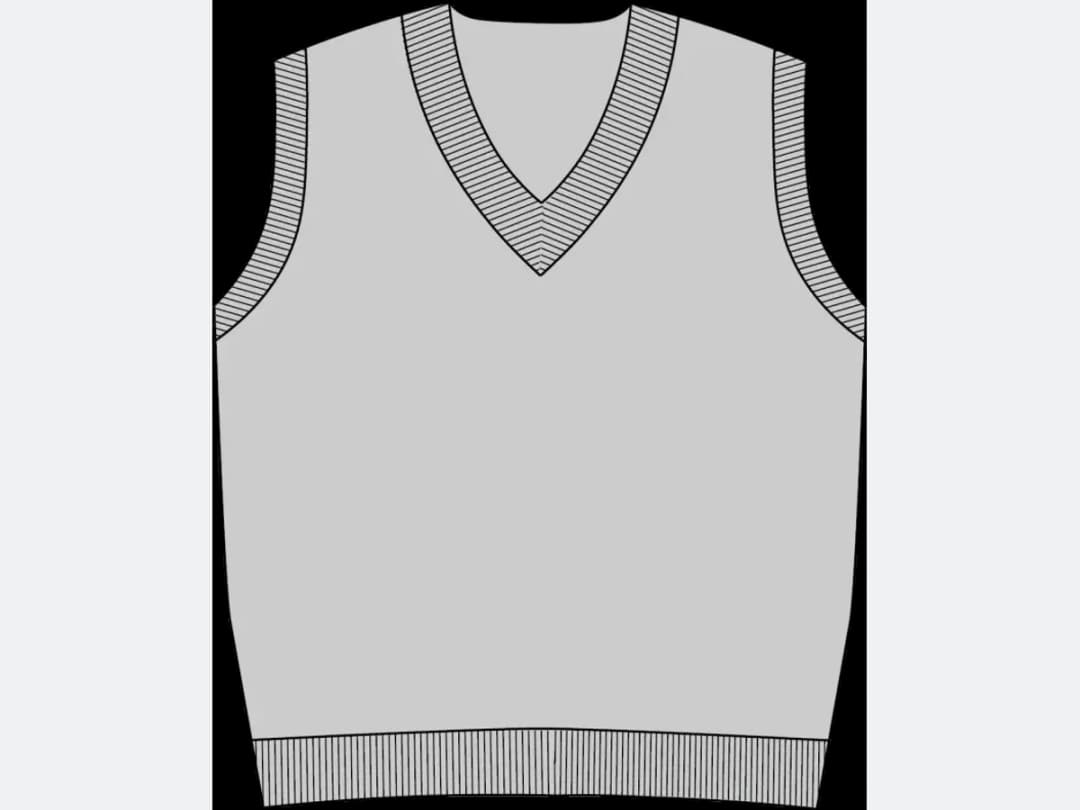
A flat sketch drawn by hand, the only input of the next image.
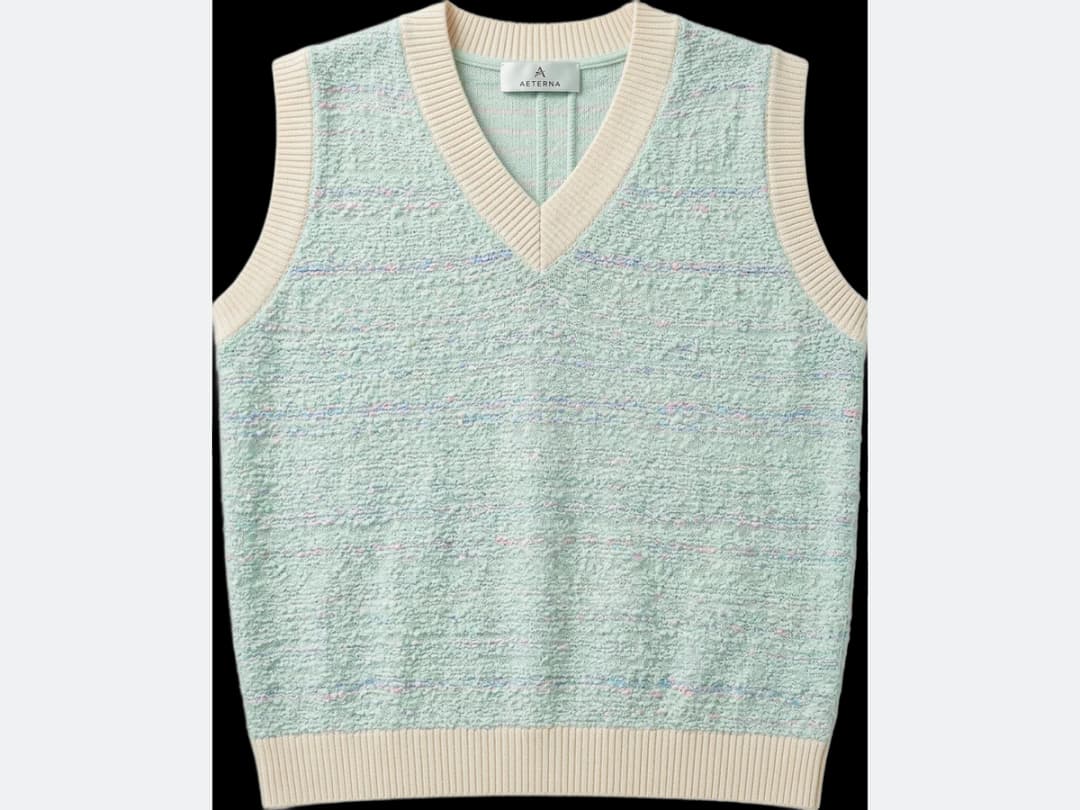
The finished vest generated on The New Black AI from that drawing: the neckline and the ribbed hem are the sketch's.
Style3D: best when you want AI design tools on top of 3D garments
Style3D started as 3D garment software and now sells an AI platform beside it. Its site lists text, image and sketch to design, variations, colourways and prints, technical drawing extraction, virtual try-on, pose change and image to video, alongside its 3D simulation with fabric drape and pattern engineering. That makes it the closest to an end-to-end tool among the 3D companies: a designer can explore an idea in AI images and move to a simulated garment in the same family of products.
Who it fits: design and development teams that want 3D fit and AI concept images from one company, and designers who already work in Style3D's 3D tools.
Price, checked November 2026: its site says new users get free credits and paid plans are available for higher use, but its pricing page did not answer when we read it, so see their site.
Honest limit: the depth is in 3D and design development. A seller who mainly needs catalogue photos and a tech pack this week will find more product than they need, and the pricing has to be read on their site before you plan a budget.
CLO: best for industry standard 3D simulation and virtual fitting
CLO simulates a garment from its pattern pieces on an avatar, with fabric physics, fit maps, colourways and rendering. Its files move between brands, suppliers and factories that already use it, and it is the 3D tool most fashion schools teach. When a brand says « we sample digitally », it very often means CLO or Browzwear.
Who it fits: pattern makers and technical designers who need to see fit and drape before cutting a physical sample, and brands whose factories already exchange 3D files.
Price: its pricing page did not load for our reader in November 2026 (it asks for a browser check), so see their site.
Honest limit: it starts from patterns, so it asks for pattern making skills, and it is not an AI image generator. Concept exploration from a sentence, product photos and marketing images are another tool's job. If you do not make patterns, it is the wrong first purchase.
Browzwear: best for 3D design and fit across a supply chain
Browzwear is a 3D design and fitting platform for brands and manufacturers, with plug-ins, a cloud workspace (Stylezone) and integrations into PLM systems. Its pricing page is unusually clear for the category: the Freelancer plan is $75 a month or $750 a year, Freelancer Plus is $150 a month or $1,500 a year and adds the latest two software versions and guest invitations, and Teams is $3,950 a year for up to three named users and 100 styles a year, with tech packs and a limited pool of 50 AI and render credits. Enterprise is by demo. Students and recent graduates can apply for a free six-month learner licence.
Who it fits: technical design teams that want 3D fit, tech packs and collaboration with suppliers in one professional tool.
Price, checked November 2026: from $75 a month (Freelancer).
Honest limit: like CLO, it is built around patterns and 3D, so it asks for technical skills, and the AI part is a small credit allowance rather than a design generator. A small brand without a pattern maker will pay for more than it uses.
Raspberry AI: best for design teams that want concepts, technical drawings and campaign images on one seat
Raspberry AI generates product visuals, technical drawings, on-model images and campaign video for apparel, footwear, leather goods, jewelry and beauty. Its module list covers concepts, prints and patterns, placement graphics, sketch to render, 3D avatar to photorealism, a design editor, a design mixer and on-body try-on. It used to be sold only through enterprise contracts; since we last wrote this page it has opened self-serve plans.
Who it fits: in-house design and merchandising teams at apparel and footwear brands, and independent creatives who want the same toolkit on one seat.
Price, checked November 2026: a no-cost plan gives 20 credits a month to try every module. Individual $49 per user a month (120 credits, exports up to 14K), Basic $198 per user a month (500 credits, bulk generation) for teams under five people, Pro $298 per user a month (750 credits, shared workspace) for teams under ten, and Enterprise on request with custom model training and private hosting.
Honest limit: the prices are per user, so a team of four on Basic is close to $800 a month. It produces technical drawings, but its pricing page does not list a tech pack with measurements and a bill of materials, and it has no store connection; a brand that sells online still needs a second tool for the product page.
Vizcom: best for sketch to render for product and footwear designers
Vizcom turns a sketch into a rendered concept and, from there, into variations and 3D views. It is used across industrial design, footwear and accessories as much as apparel, which is why it comes up when designers ask whether a general design tool is better than a fashion-specific one. Its pricing page says paid users' images and designs stay private and are not used to train models; free users' generated images may be used to improve the service.
Who it fits: designers who think with a pen, footwear and accessory teams, and studios that render concepts for clients.
Price, checked November 2026: its entry plan costs nothing and includes 800 credits. Professional is $49 per user a month with 20,000 credits, priority rendering and credit add-ons; the annual toggle saves 30%. Larger plans are by demo.
Honest limit: it is not built around garments: there is no tech pack, no measurement chart, no fabric workflow and no on-model catalogue. It shines at the render and stops there.
fashionINSTA: best for DXF patterns trained on your own archive
fashionINSTA calls itself pattern intelligence. It trains on a brand's own production DXF archive, then retrieves the closest pattern for a new design or generates new patterns from the trained building blocks, with automatic points of measure, tech pack generation, a fabric sourcing step that returns real fabric names, compositions, prices and minimum orders, and a feasibility check against a target price. Outputs open in CLO, Style3D, Browzwear, Gerber, Lectra and other CAD tools.
Who it fits: established brands and manufacturers with hundreds of production patterns and a pattern room that grades and cuts.
Price, checked November 2026: an Enterprise pilot of €5,000 to €15,000 one time (ten weeks, one category, 100 to 150 of your patterns trained, up to 10 seats), then Fashion Complete OS at €23,900 a seat a year. The free tier our September version mentioned is no longer on the site, so we removed it.
Honest limit: the value comes from your archive, so a new brand has nothing to train it on, and the entry ticket is an enterprise project. It is not a product photography tool.
NewArc.ai: best for a fast sketch to realistic render
NewArc.ai turns a sketch or drawing into a realistic image, with tools for materials, patterns and colourways, image to sketch, a light try-on and image to video. Its site features freelance designers who use it to show new brands a product before a sample exists, which is exactly the job it does well.
Who it fits: freelance designers and small studios presenting concepts to clients, and students (it has an education offer).
Price, checked November 2026: a tier at no cost gives 210 credits a month. Basic is £9 a month billed yearly for one user with sketch to image; Pro is £19 per user a month billed yearly, up to five users, for companies under $1 million in yearly revenue. Larger teams are by quote.
Honest limit: it stops at the image: no tech pack, no measurements, no on-model catalogue and no publishing. Plan for a second tool once the design is approved.
LookFashion: best for a live render while you draw on a tablet
LookFashion (LOOK AI) renders a sketch into an image in real time as you draw, on an iPad or a computer, with fabric and print rendering, virtual try-on, collage and visual search. It is a sketching companion: you see the garment change as you move a line.
Who it fits: designers who draw every day and want instant feedback on a silhouette, and teams that brainstorm together (team plans share credits and assets).
Price, checked November 2026: every account receives 100 credits a day at no cost. Paid plans begin at $30 a month or $288 a year, with 3,000 or 10,000 monthly credits and a 3-day free trial when you link a card. Plan credits last 30 days, daily credits 24 hours, purchased credits a year, and failed tasks are refunded.
Honest limit: it is about the drawing moment. Production documents, measurements and product photos are out of scope.
StyTrix: best for a design canvas with style training
StyTrix is a fashion design canvas where you generate and iterate on concepts, with image to sketch, video, studio shots and multi-angle views on higher plans, and style training to keep a look across designs.
Who it fits: independent designers who want a dedicated canvas and a predictable monthly allowance.
Price, checked November 2026: a no-cost plan gives 30 credits, valid for 30 days, with no card. Then $19 a month for 250 credits; $49 for 750 credits with rollover; $99 for 1,500; Enterprise custom. Top-up packs never expire, and yearly billing gives two months free.
Honest limit: it stops at the image: no tech pack with measurements and no store connection.
Yoona.ai: best for collection planning from trend and sales data
Yoona.ai sells AI agents for product and e-commerce teams in fashion, footwear and apparel: a trend forecaster, a sales confidence score for every product before you scale it, and a product optimiser, connected to a brand's own systems and data. It belongs on a design list because it decides what to design, more than how to draw it.
Who it fits: merchandising and planning teams at brands with enough sales history to feed it.
Price: by demo, see their site.
Honest limit: it plans and recommends; it does not take a piece to a sketch, a tech pack or a product page.
What a design really costs
Per-design prices are hard to compare. Every company sells credits, every action spends a different number of them, and most pricing pages do not say how many credits one garment design takes. What can be compared is the first paid month for one designer, and on The New Black AI, where the credit cost of each step is published, the cost of a whole collection.
| Tool | First paid month, one designer (Nov. 2026) | What the month includes |
|---|---|---|
| The New Black AI | $15 (Starter) | 200 credits a month. A design or flat sketch is 1 credit on Standard, and a tech pack built by hand costs nothing |
| StyTrix | $19 | 250 credits |
| LookFashion | $30 | 3,000 credits plus 100 a day |
| Raspberry AI | $49 (Individual) | 120 credits |
| Vizcom | $49 (Professional) | 20,000 credits |
| Browzwear | $75 (Freelancer) | 3D design and fit, one user |
| NewArc.ai | £9 billed yearly (Basic) | 96,000 credits a year |
A credit at one company is not a credit at another, so read the table as an entry ticket, not as a price per design. The real cost is the number of tries before a design is approved, plus the hours spent describing it again and moving it from one tool to the next.
Worked example: a 12-style capsule collection, priced
A brand designs a 12-style capsule and takes every style to the factory and to its store. On The New Black AI, for each style:
- 3 design iterations to settle the piece: 3 × 1 credit = 3 credits (Standard).
- 1 print for the fabric: 1 credit.
- 1 flat sketch from the chosen design: 1 credit.
- A tech pack drafted by the AI from the design: 1 credit, plus 1 credit for the AI flat sketch on the plate.
- 4 sections rewritten in their AI window (description, size chart, bill of materials, notes): 4 × 1 = 4 credits.
- 1 AI review of the finished pack: 2 credits.
- 3 on-model photos for the product page: 3 × 1 = 3 credits.
That is 3 + 1 + 1 + 2 + 4 + 2 + 3 = 16 credits a style, so 12 styles × 16 = 192 credits. One month of the $15 plan (Starter) includes 200 credits, so the capsule fits inside it. The PDF exports cost nothing.
At Pro quality, every image step costs 3 credits instead of 1: designs 9, print 3, flat sketch 3, photos 9, that is 24 credits, plus the 8 credits of tech pack steps, which do not change. That is 32 credits a style, 12 × 32 = 384 credits, inside one month of Pro ($35, 500 credits), with 4K available.
If you build the tech packs by hand rather than with the AI, take 8 credits a style off: 96 credits on Standard. These numbers assume three tries per design; a brand that tries ten times should multiply the design line, not the rest.
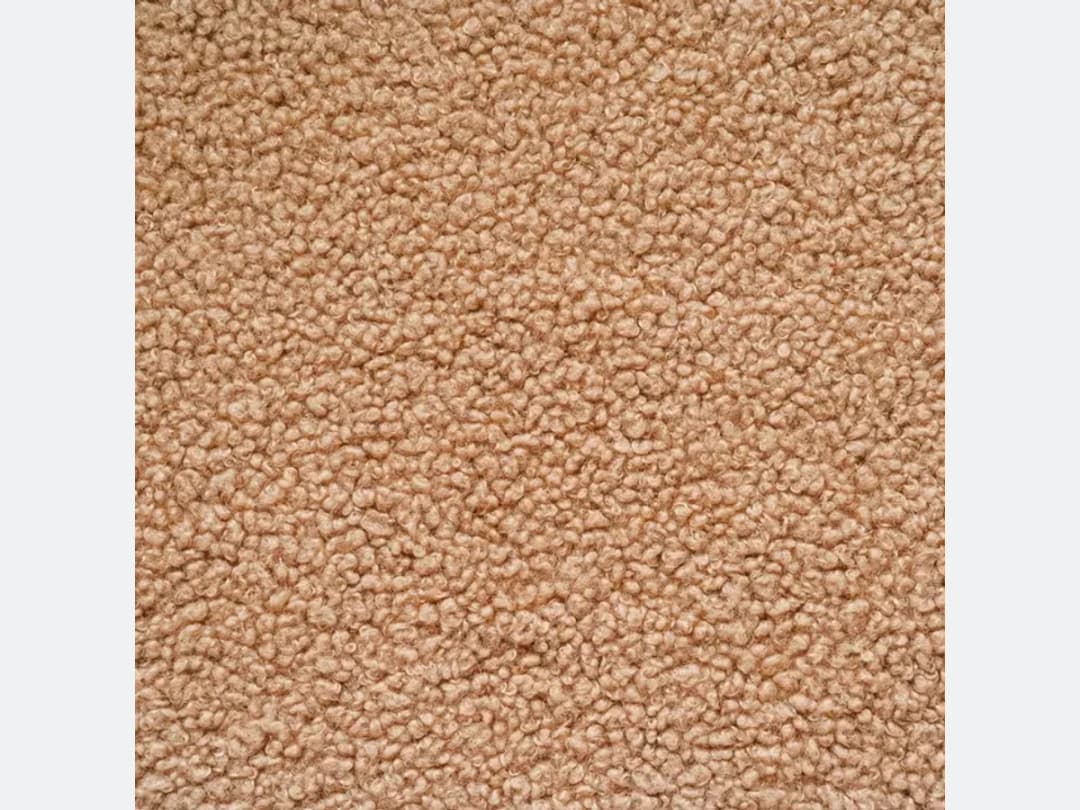
A fabric swatch photographed flat, the starting point of one style of the capsule.
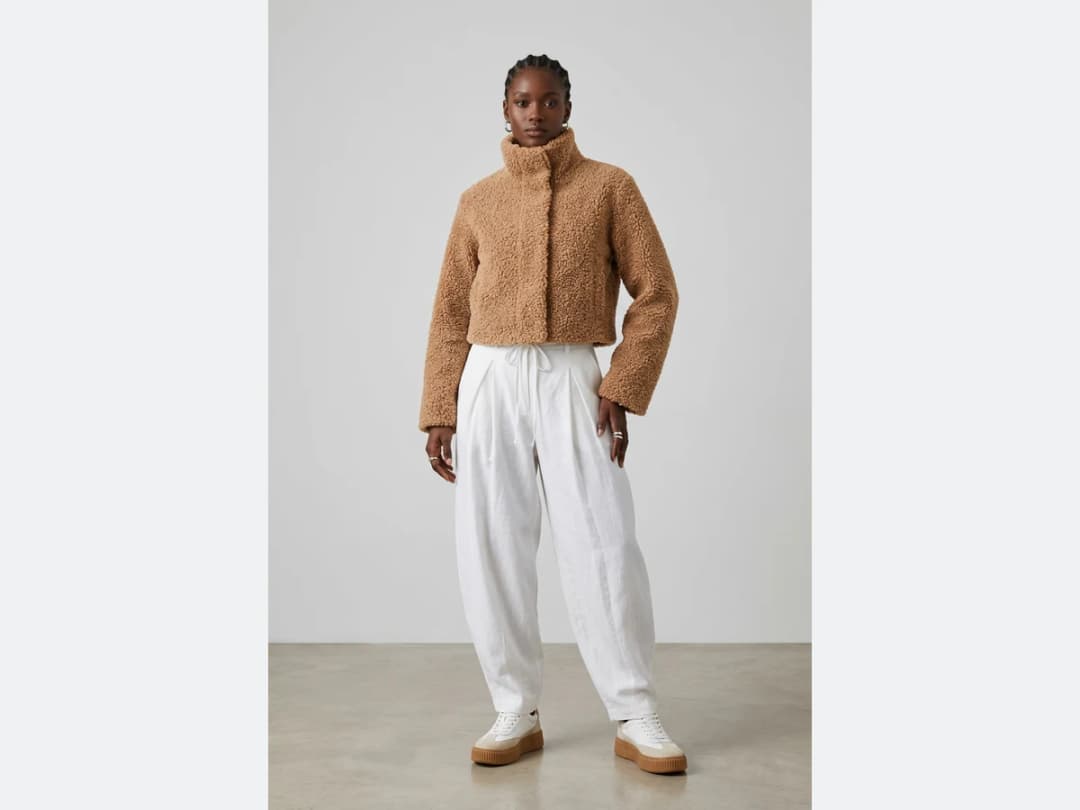
A cropped jacket generated on The New Black AI from that swatch alone, ready to be drawn flat and sent to the tech pack.
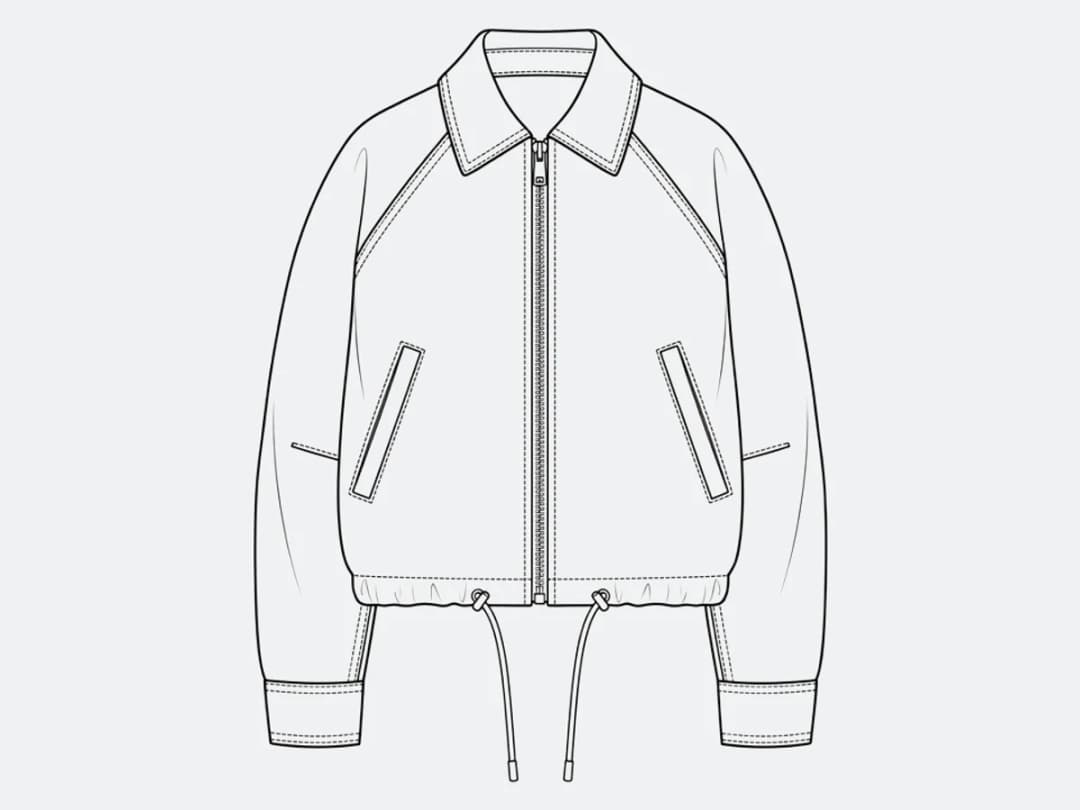
A flat sketch drawn by The New Black AI from a garment photo, the drawing the tech pack is annotated on.
How to choose
A small brand designing and selling its own collection
Start with The New Black AI: one account covers the design, the fabric, the flat sketch, the tech pack and the product photos, and a 12-style capsule fits in one Starter month, as worked out above. Add a 3D tool only when fit becomes the problem.
A designer who draws by hand and wants a render in seconds
Vizcom, NewArc.ai and LookFashion are built around the sketch. LookFashion renders while you draw, NewArc.ai is the cheapest entry on a yearly plan, and Vizcom suits footwear and accessories. If the render must then become a tech pack and a product photo, The New Black AI's sketch to design keeps the chain in one place.
A technical design team that needs fit before the first sample
CLO or Browzwear. Both simulate garments from real patterns; Browzwear publishes its prices, from $75 a month, and its Teams plan lists tech packs. Style3D is the choice if you also want AI concept tools from the same company.
A large brand with a pattern archive
fashionINSTA trains on your own DXF patterns and returns graded patterns, points of measure and tech packs that open in your CAD software. Budget an enterprise pilot first, then a yearly licence per seat.
An in-house design and merchandising team
Raspberry AI gives each designer concepts, technical drawings and campaign images on one paid seat, with team plans and private hosting on Enterprise. Yoona.ai sits upstream, helping decide which products to design from trend and sales data.
A design team that does not want its work used for training
Read each company's own terms before uploading a collection. The New Black AI says uploads and creations are private and never used to train a model, on any plan; Vizcom says the same for paid plans only; Raspberry AI offers private hosting on Enterprise.
Shoes, bags and accessories rather than clothing
The New Black AI has dedicated workflows for shoes and bags; Vizcom and Raspberry AI both list footwear and accessories among their industries.
Whatever the shortlist, give the same brief to two or three tools before you commit: one knit, one structured jacket, one print and one piece you know by heart. If your job is a whole season from the idea to the product page, that is what we build The New Black AI for, and the free credits at signup are enough to run that test. For the families of design software rather than individual tools, read our guide to clothing design software, and for the wider market, the best AI tools for clothing brands.
Sources
- The New Black AI, plans and workflow credit costs, read from our own catalogue (November 2026).
- Style3D, AI fashion design home page, https://www.style3d.ai (checked November 2026).
- Style3D, Best AI Fashion Design Tools in 2026, https://www.style3d.ai/blog/best-ai-fashion-design-tools (checked November 2026).
- CLO, pricing, https://www.clo3d.com/en/pricing (did not load for our reader, November 2026).
- Browzwear, pricing plans, https://browzwear.com/pricing-plans (checked November 2026).
- Raspberry AI, pricing, https://www.raspberry.ai/pricing (checked November 2026).
- Vizcom, pricing, https://www.vizcom.ai/pricing (checked November 2026).
- fashionINSTA, home page and plans, https://fashioninsta.ai (checked November 2026).
- NewArc.ai, home page and pricing, https://www.newarc.ai (checked November 2026).
- LookFashion, pricing, https://www.lookfashion.ai/pricing (checked November 2026).
- StyTrix, pricing, https://www.stytrix.com/pricing (checked November 2026).
- Yoona.ai, home page, https://www.yoona.ai (checked November 2026).
Frequently asked questions
What is the best AI fashion design software in 2026?+
For a brand that designs, documents and sells its own pieces, our pick is The New Black AI (we make it): design, fabric, flat sketch, tech pack and product photos in one account from $15 a month. For 3D fit before sampling, CLO or Browzwear; for a fast render from a sketch, Vizcom, NewArc.ai or LookFashion.
What is the best AI clothing design software for a small brand?+
One that covers several steps, so you pay for one plan instead of four. On The New Black AI a 12-style capsule, from design to tech pack and three product photos per style, is about 192 credits. The $15 plan includes 200 credits a month, so it fits.
Is there free AI fashion design software?+
Several tools let you start free: The New Black AI gives free credits at signup and builds tech packs by hand at no cost, LookFashion gives 100 credits a day, NewArc.ai 210 credits a month, Raspberry AI 20 credits a month, Vizcom 800 credits, and StyTrix 30 credits for 30 days. None is free for a whole collection.
Can AI design clothes from a sketch?+
Yes. The New Black AI, Vizcom, NewArc.ai, LookFashion and Raspberry AI turn a sketch into a realistic garment image; fashionINSTA turns it into DXF pattern files.
Does AI fashion design software replace CLO or Browzwear?+
Not for fit. CLO and Browzwear simulate fabric on a body from real patterns; AI design tools create concepts, renders, documents and product images. Many brands use one of each.
Can I make a tech pack with AI fashion design software?+
Yes. The New Black AI drafts a tech pack from a design, photos or sketches for 1 credit and writes each section in its own AI window for 1 credit. The PDF export costs nothing; Browzwear lists tech packs on its Teams plan, and fashionINSTA generates them next to its patterns.
Is there an AI fashion design tool that does not train on my designs?+
The New Black AI states that uploads and creations are never used to train a model, on any plan. Vizcom says the same for paid users, and Raspberry AI offers private hosting on Enterprise; read the terms of any tool before uploading an unreleased collection.
Which AI fashion design software is best for large apparel brands?+
Large brands usually combine a 3D platform (CLO or Browzwear) with an AI layer: Raspberry AI for concepts and technical drawings, fashionINSTA for patterns from their archive, and Yoona.ai for planning from sales data.
Related articles
- 9 Best AI Moodboard Tools for Fashion Designers (2026)9 AI moodboard tools for fashion designers compared in November 2026: what each fits, prices checked, free options, and a 12 look capsule priced.
- 10 Best AI Fashion Studios for Brands in 2026 (Compared)10 AI fashion studios compared (Nov. 2026): what each holds (design, photos, video, tech packs, Shopify), team seats, prices, and a 20-piece month priced.
- 8 Best Free AI Fashion Design Software (2026)What each free AI fashion design tool really gives in 2026: free plans, daily credits, trials and watermarks, read on each site, and a capsule priced.
- 9 Best AI Jewelry Design and Photography Tools (2026)9 AI jewelry design and photography tools compared, Nov. 2026: CAD files, worn shots, video, Shopify, prices checked and a 40-piece drop priced.
- 10 Best AI Ad Generators for Clothing Brands (2026)Ten AI ad generators compared for clothing brands: what each fits, prices read November 2026, a month of fashion ads priced, and which ones run Meta and Google.
- 8 Best AI Fashion Photoshoot Generators (2026)8 AI fashion photoshoot generators compared, November 2026: model, setting, angles, video, prices read on each site, and a 12-look campaign shoot priced.
- 8 Best CLO3D Alternatives in 2026, Free and Paid8 CLO3D alternatives compared, Nov. 2026: free open source pattern tools, 3D suites, and AI from sketch to tech pack, with prices read on each site.
- 8 Best Photoroom Alternatives in 2026 (Compared)8 Photoroom alternatives for clothing brands, November 2026: who each fits, 2K and 4K fashion prices, API, Shopify and video, with a 60-piece season priced.
- 8 Best AI Product Photo Tools for Clothing Brands (2026)Eight AI product photo tools for clothing brands compared: what each fits, the price of one 2K photo, and a 40-piece drop priced. Updated November 2026.
- 9 Best AI Lookbook Generators and Makers (2026)Nine AI lookbook generators compared: on-model photos, layout and an online book, prices read November 2026, and a 12-look seasonal lookbook priced.